
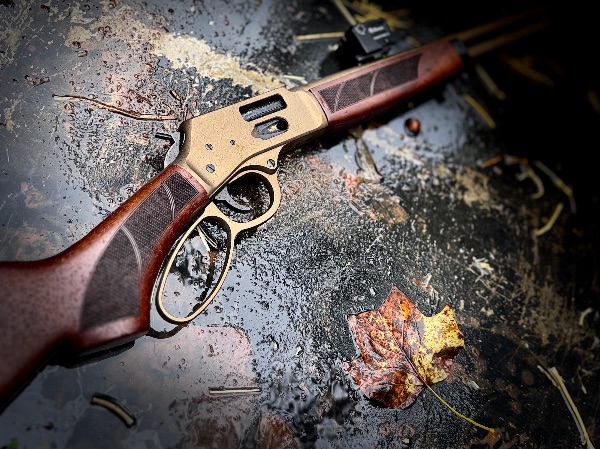
Henry Repeating Arms’ H12 Explorer Carbine in .357 Magnum looks pretty good against the fall colors, but fall is also when a rifle like this makes the most sense to me. It’s short, handy and easy to carry through the woods.
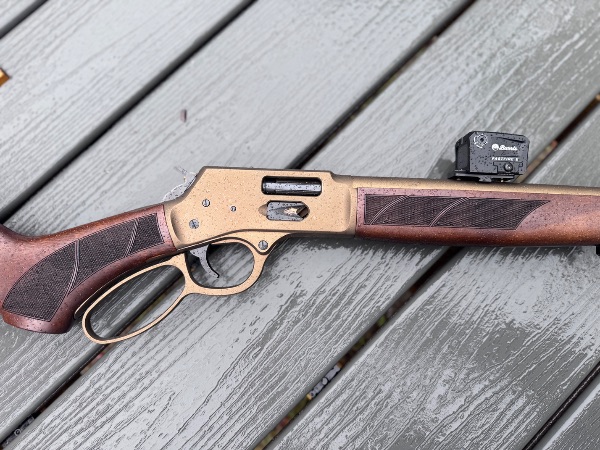
Technically, the H12 is a compact package. Its 16.5-inch threaded barrel keeps overall length to about 34 inches, while a weight of roughly 6.6 pounds gives the rifle enough mass to make the .357 Magnum exceptionally manageable without taking away the quick handling I want from a pistol-caliber carbine. Henry combines its side loading gate with a removable inner magazine tube which is a helluva lot handier than you may realize when you consider I can load it with the suppressor in place. Burnt Bronze Cerakote protects the metal, and checkered American walnut keeps the rifle from losing the traditional look and feel of a lever gun. The carbine-length barrel also lets the .357 Magnum take advantage of considerably more velocity than it typically produces from a revolver.
Why the 357 Magnum?
Well, first and foremost - it's no bride's maid. It's a bad $itch all by itself. The .357 Magnum isn’t underpowered. It’s underestimated, usually by people who’ve never hunted with one.
The .357 Magnum has been around since 1935, developed by Smith & Wesson with considerable input from firearms writer and experimenter Philip B. Sharpe and legendary outdoorsman Elmer Keith. Based on a lengthened .38 Special case and originally introduced in Smith & Wesson’s magnum revolver, it was the hot handgun cartridge of its day and quickly earned a reputation for considerably more power and reach than the service revolver cartridges that came before it.
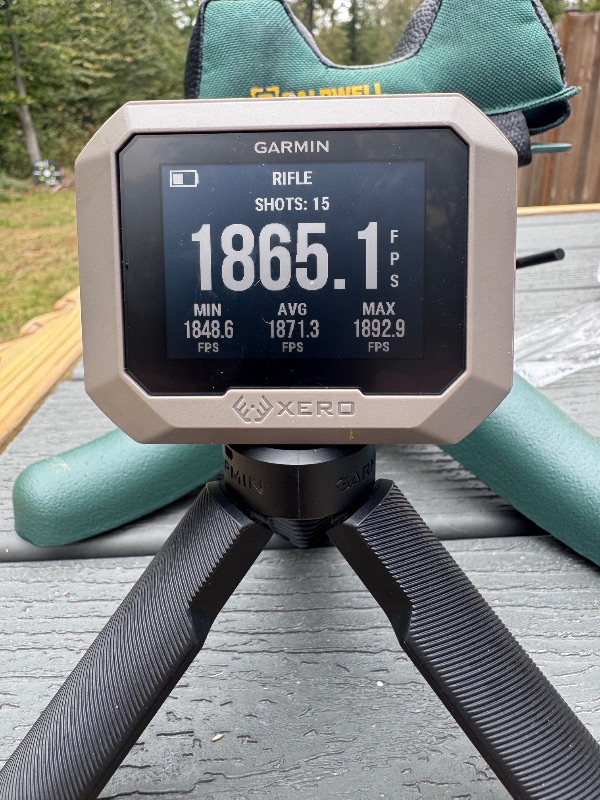
Nearly a century later, I think we sometimes underestimate the .357 Magnum, especially when we put it in a carbine. Give the cartridge a 16- to 20-inch barrel and it becomes a different animal than the .357 most of us know from a handgun. Loads designed for lever guns can gain substantial velocity, shoot relatively flat across normal woods distances and produce very manageable recoil. With a properly constructed hunting bullet and sensible shot placement, the .357 Magnum has plenty to offer for deer at close to moderate range. It isn’t a .30-06 and shouldn’t be treated like one. Inside roughly 100 yards, though, a .357 carbine combines mild recoil, fast handling and enough performance to make it a very useful, and often underrated, deer rifle.
In fact, if you think the .357 Magnum is too small for deer, the cartridge probably isn’t the weak link in the equation.
I mounted a Burris FastFire E using the Skinner Sights ACRO barrel mount, and the combination worked exceptionally well. The FastFire E is small and light enough that it doesn’t change the character of the Henry. The Skinner mount keeps it low on the barrel, and the rifle still comes up naturally.
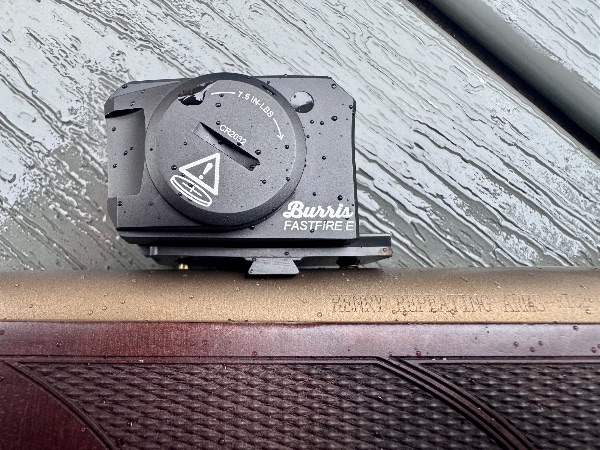
I was probably more impressed with the Burris than I expected to be. The dot was bright and crisp, and the sight proved precise enough that hits on a four-inch steel plate at 100 yards became routine. With a 3.5-MOA dot covering roughly 3.7 inches at 100 yards, that’s pretty darn good performance from a little non-magnified optic.
The FastFire E is an enclosed-emitter sight, which I also think makes sense on a hunting rifle. The enclosed design doesn’t automatically make the sight brighter or clearer than an open reflex sight. What it does is protect the emitter from rain, snow, mud, leaves and whatever else I manage to drag a hunting rifle through. A recent rain-filled squirrel hunt with a reflex-sighted handgun taught me what rain can and will do to an open-style reflex sight, and thats render it useless without repeated wipe downs. The bright, clean sight picture I experienced comes from the quality of the optic. The enclosed housing helps make sure I still have that dot when the weather gets lousy.
I have since learned the FastFire E's limits with timber and shadows at distance its nemesis. So much so, that the Henry may have a magnified optic added to its receiver soon.
For ammunition, I shot 130-grain MonoFlex, 140-grain FTX, 158-grain XTP Hornady loads, and some Herter's 158-grain Target loads too. Based solely on accuracy Hornady’s LEVERevolution .357 Magnum load with the 140-grain FTX bullet is my go-to load.
I also spent a few minutes on the phone with Hornady's Preston Lentfer, who I got to know on a Smith & Wesson lever-action elk hunt last year. He took his bull elk with a 30-30 Winchester at about 300 yards on that trip, and it reminded me that if bullet placement is king, then bullet design is queen. After an obnoxious amount of questions, the ever-patient giant (Preston is about two Jay Pinsky's tall) helped me better understand the LEVERevolution line of bullets and why they work better and differently than other 357 Magnum choices.
I sighted the Henry with the 140-grain FTX and found the combination essentially dead-on out to 100 yards. Technically its .14 of an inch low at 100 based on a dead-on zero at 25 yards. At 125 yards I was seeing about two inches of drop and by 150 it was around five inches. You can certainly shoot a .357 Magnum farther than that, but punching steel and shooting an animal are two different things.
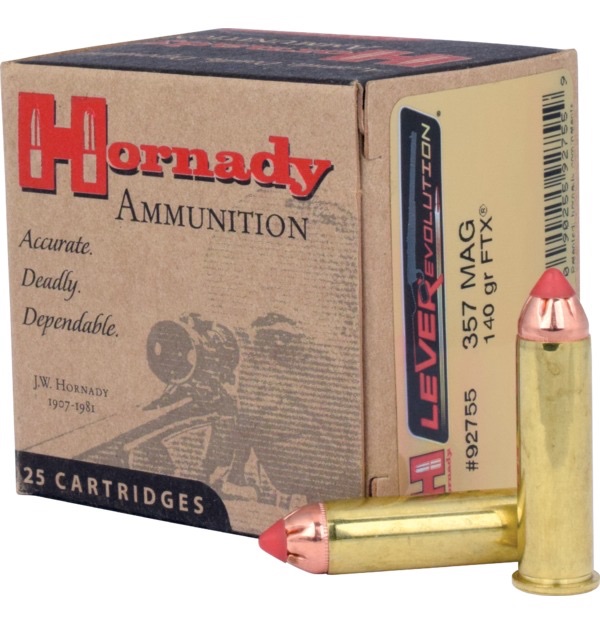
I’ve never killed anything with a .357 Magnum(yet), so I talked to people in our hunting community who have like Larry Weishuhn, Richard Mann, and Shane Jahn. They were pretty emphatic about considering 100 yards a long shot with the cartridge on deer-sized game. I’m going to listen to people who have actually done it. My limit with the Henry will be 100 yards, and most of the shots I’d expect to take in the Virginia woods will be considerably closer. I should also note that I have yet to get my hands on Federal's HammerDown 357 Magnum loads, which many gun writers swear by. The West Virginia gun writer in that group insists it's the only ammo I should use.
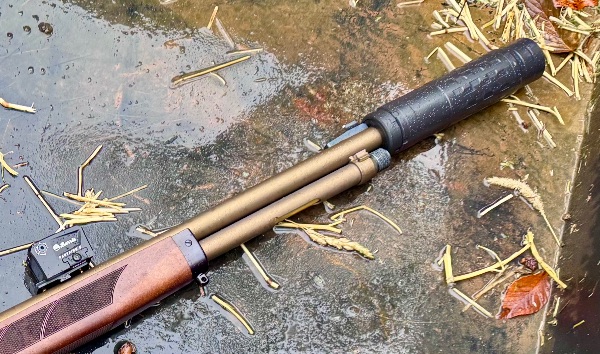
The H12 is also part of a larger look I’m taking at the .357 Magnum. I’ll be spending time with my Smith & Wesson Model 686 with its 8 3/8-inch barrel and a six-inch Chiappa Rhino Hunter. Same cartridge, three very different firearms, and a chance for me to learn what the .357 does well from both rifles and handguns.
A lot of this also goes back to my Handgunning for Squirrels project. I started that series with a Ruger Single-Six .22 Magnum and a pretty simple goal: become a better handgun hunter. I set a ten-yard limit, shot from supported positions and came up with my own standard of MOS — Minute of Squirrel. If I couldn’t consistently make the shot on the range, I had no business trying it on a squirrel.
Here’s a tightened version that keeps your voice and, especially, that line about asking the .357 to be something it isn’t.
That micro-focus on squirrels has made a significant difference in my handgun shooting, and I’m pretty proud of the accuracy gains I’ve seen.
With all due respect to the bushy-tailed critters, Handgunning for Squirrels was never entirely about squirrels. They gave me a very small target and absolutely no reason to get sloppy. The whole point was to make me significantly better as a hunter and shooter.
That’s exactly what is happening.
The patience, trigger control, supported shooting and discipline I’ve been working on with the little Single-Six are carrying over to the centerfire handguns. I’m shooting better than I was when I started this project, but maybe more importantly, I’m much more aware of where my limits are.
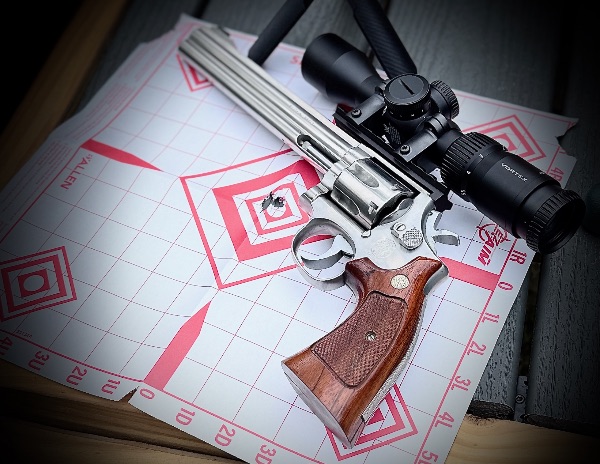
Those two things go together.
I’ve also become pretty fond of the .357 Magnum in the process. It’s manageable to shoot, hits harder than I think a lot of us give it credit for, and most importantly, I shoot it well.
The fact is, the only way the .357 Magnum isn’t enough is if and when I ask it to be something it isn’t.
Which, come to think of it, may be a life lesson for me. Maybe for you, too.
There’s something to be said for understanding what something does well, respecting what it doesn’t, and then getting as good as you possibly can within those boundaries. That applies to cartridges, handguns, hunting, and probably people.
In the meantime, I’m having a heck of a time popping 8-inch plates at 100 yards with the little Burris green dot on the Henry.
Turns out chasing squirrels with a handgun taught me a lot more than how to hunt squirrels.
And I’m having a hell of a lot of fun finding out just how much.
– Jay Pinsky