
A child draws a bow, the string leaves their fingers, and the arrow makes that short trip downrange. Then comes that wonderful little thwack of an arrow finding the middle of the target.
We’ve all been there. For the experienced, it's a reassuring sound; for any new archer, it's the sound of confidence.
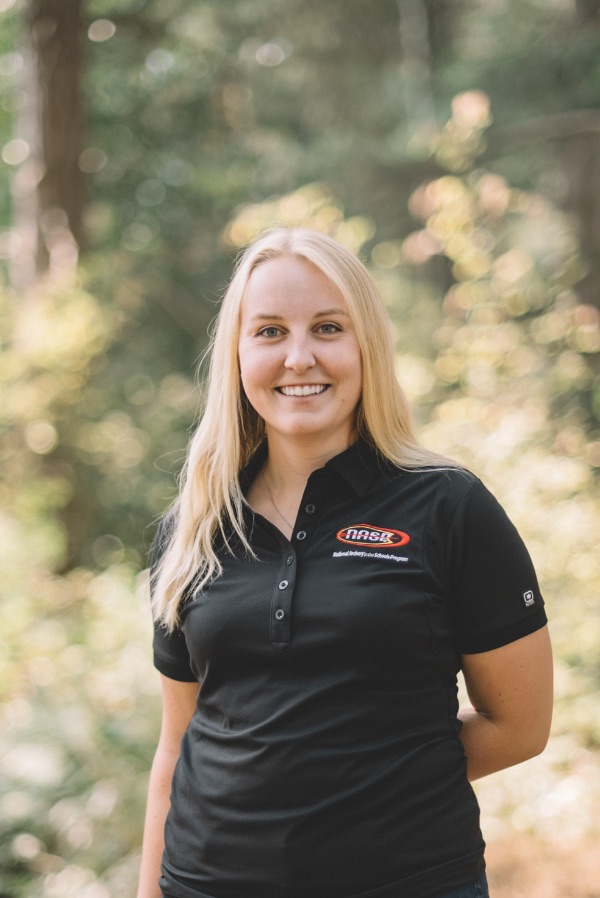
“The archer, young or old, always seems to whip their head around to look at me as if to confirm, ‘Did I really do that?’ with a whoop and a big smile across their face. I have to smile right back at them,” said Stephanie Evans, NASP’s Program Manager.
I think that’s probably the best way to understand Stephanie Evans and the National Archery in the Schools Program.
You can talk about bows, arrows, tournaments, and the 11 Steps to Archery Success. You can certainly talk about the nearly 1.3 million children NASP® reaches every year, but numbers don’t turn around and smile at you.
Children do - and as a father, let me affirm that there’s no greater reward than that look Stephanie and countless other archery mentors get to see.
Stephanie has spent much of her life watching what happens after children realize, maybe for the first time, I can do this.
I'll let you in on a little secret, Stephanie - you may have jobs that come with more pay, more responsibility, or more adventures, but you’ll never have one with a greater reward.
I think Stephanie may understand it better than most. Why? Because she’s been that kid …
The Quiet Kid
Stephanie was 11 when archery entered her life, and she remembers being a very different kid before she found it.
“I can relate this question to my own experiences. I think the most common trait students pick up from archery is confidence. I noticed that as a young archer myself. I was once the shy and quiet girl who didn’t speak up in class, but when I found archery, I also found a group where I felt safe and supported. I started speaking up more.”
I often refer to this sort of thing as the "Mr. Holland’s Opus" concept. Doing something different, hard, or otherwise outside of your normal can, and usually does, make the difference in a child’s development because of the confidence, love for learning, and bravery it instills. Archery doesn't have to be what you do with your life to make a difference in your life. That's true for adults too, by the way.
Archery gave her a place where being herself worked, and over time, Stephanie figured out something important about the source of that confidence.
“The more I think about it though, confidence comes from feeling like you belong. It comes from feeling like you are part of the archery community, which really does become a family.”
Today, she watches the same transformation happen to other kids.
“I first meet them during their elementary school years, and they hide behind their mom while we speak. A few years later, they speak with confidence about who they are, and part of their identity becomes ‘I am an archer’.”
Talk about empowerment!
On the Line
Kids spend an awful lot of their lives figuring out where they fit (It's not just kids). Who’s fastest, strongest, popular or better? Archery has a funny way of making a lot of that noise disappear.
“In archery, when you stand on the shooting line, the only person you are trying to beat in that moment is yourself. Popularity, looks, physical strength, age, and speed all disappear.”
Stephanie watched that play out beautifully at a state competition when a high school boy was shooting beside an elementary school girl on the 3D range. He was hitting bullseyes while she was missing almost everything. His score mattered, but he helped her anyway.
“In between ends, he made sure to ask her where she was aiming and then showed her the next target to offer suggestions on adapting her aim point. If she had a bounce out, he made sure she raised her hand to get another arrow. He had patience while she was shooting and encouraged her after every arrow.”
Nobody told him there was a trophy for helping that little girl, and helping her certainly wasn’t going to improve his score. He simply did it.
“This moment was memorable, but it happens all the time because the shooting line is a special place, where everyone is just another archer, and archers want to see one another succeed.”
That’s a pretty good definition of sportsmanship and maybe an even better definition of character.
The Bullseye Moment
Stephanie has a name for the instant somebody discovers they’re capable of something they weren’t sure they could do: the bullseye moment.
“I know that NASP® has succeeded every time I stand on the range with an archer, whether it’s students in 4th-12th grade or one of our BAIs, and they have their bullseye moment. I get to watch as the string leaves their fingers, the arrow flies to the target, and lands with a thwack right in the center.”
She doesn’t particularly care whether that shooter eventually becomes great.
“Even if a student never becomes a great archer, if I can help them find their bullseye moment, and they feel like archery was something they could be successful at, then NASP® has succeeded at changing a life, one arrow at a time.”
That’s what makes the idea so appealing. The bullseye is important, but what happens inside the person who shot it may be much more important.
“It’s Just NASP®”
Stephanie occasionally hears something from people in the archery industry that bothers her.
“‘It’s just NASP®’ is a phrase I hear used in the industry a lot, along with the misconception that these kids aren’t using real bows and they aren’t real archers. If you said that to one of our NASP® kids, they would be sure to set you straight.”
I suspect I’d enjoy watching them do it.
“Shooting a bare bow with no sights, a simple rest, and no extra weights – it’s not easy. Could the best archers today pick up a Genesis bow, walk out to 15 meters, and hit five bullseyes? Some NASP® shooters sure can.”
But the bigger mistake in saying “just NASP®” isn’t underestimating the equipment. It’s underestimating the kids and maybe underestimating where that first arrow can eventually lead them.
Stephanie knows a girl from a family of hunters who hadn’t pictured herself participating until her NASP® program introduced 3D targets.
“She told me it wasn’t until after she tried NASP® at school, and her program incorporated 3D targets, that she thought, ‘I could do that too’.”
Four simple words, "I could do that too," can open an awfully big door.
More Than Archery
NASP® has changed Stephanie too, and one of the lessons she carries with her has almost nothing to do with shooting.
“I used to think that when I gave instructions, and people didn’t follow them, it was because they weren’t listening or paying attention, but I have learned that maybe the way I explained it just wasn’t right.”
She even learned a version of that lesson while her husband was teaching her to drive his manual flatbed truck. His instruction for shifting was to “just feel it.”
“I definitely stalled it.” (Been there, done that, Stephanie)
Of course she did. “Just feel it” may be one of history’s least useful pieces of instruction, but the stalled truck taught her something useful.
“One explanation does not always work for everyone, and it is my job to find the words that work for them.”
That’s good coaching, probably good parenting and certainly good leadership. It also turns out NASP® isn’t only teaching the kids.
An Archery Family
Stephanie was 11 when archery changed her world. Now sharing it with other kids is hers.
“Archery became my whole life at age 11, and now I get to share the experience with a whole world of kids. It’s not often that you get to share your passion on an international scale.”
After six years with NASP®, tournaments are filled with familiar faces. Kids grow up, families return, and they laugh together and sometimes cry together. Occasionally the job description even expands in unexpected ways.
“Sometimes I am even sneaking a family out the back door of a tournament to avoid getting medical devices wet in a Florida thunderstorm.”
That’s not in the 11 Steps, but maybe it should be.
“I love NASP® because students find their archery family, and I get to help make that possible.”
One Arrow at a Time
Nearly 25 years after the first Kentucky students learned the 11 Steps, Stephanie hopes NASP® continues to grow.
“I hope that twenty years from now, twice as many people know what NASP® is and that it becomes a common household name.”
And the students?
“I hope that I can make it a fun experience for as many kids as possible, that the education we share makes archery feel approachable, and that the confidence they find stays with them their whole lives and helps them build stronger communities.”
Stephanie’s wisdom and maturity shined during this interview when she affirmed that the target was never really the point. The student was. If ever there was a “Hallmark Moment” for NASP®, I'd say that’s one.
Somewhere on a NASP® range today, an arrow is going to leave a string, cross the range and bury itself right in the middle with that unmistakable thwack. A kid is going to turn around with a look that asks, Did I really do that?
Thanks to NASP®, someone like Stephanie Evans will be there to smile back and say “yes, you did” because sometimes the most important bullseye isn’t on the target at all.
- Jay Pinsky