

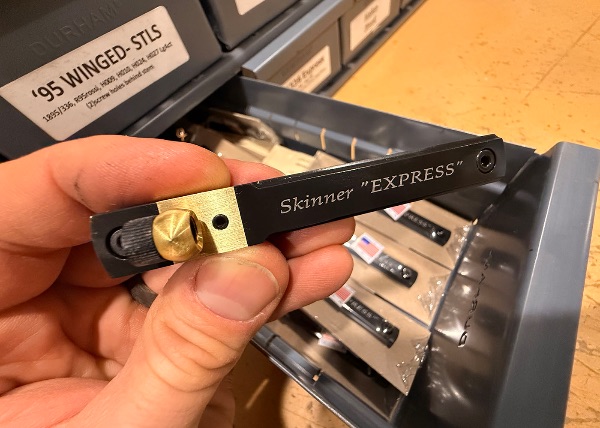
The Skinner Black Gold Express Sight is our classiest look at Skinner Sights.
This sight goes beyond function without sacrificing quality and durability. Based in Montana, Skinner Sights was founded by a genius because of a lack of durability. Dr. Tim Skinner was hunting on horseback with his Marlin carbine in a scabbard. On two occasions his sight failed, so he designed one that wouldn’t break. With this first “Skinner Sight,” he laid the foundation for the Skinner business which he sold to my father, Andy Larsson a couple years later.
I was leaving the house a few years ago while my in-laws were visiting. I grabbed a rifle and headed out the door. My younger brother-in-law asked my wife if I was going hunting. Her reply? “No, he’s just leaving the house.” In other words, this is just normal life for us. We live with guns. We have Grizzly bears in our yards, mountain lions travel the creeks behind our houses, and there is ever a starling or a coyote that is endangering civilized life. The very life we live illustrates why Andy was the perfect fit for advancing Dr. Skinner’s design and legacy.
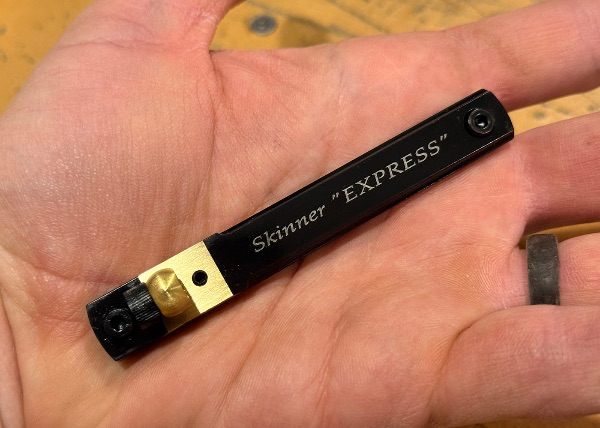
What he designs must work. He is also offended by sights that lack aesthetics, looking like a blister on your rifle. He streamlined Skinner’s design and called it the Express sight. Then, to compliment the Marlin’s gold trigger, why not put a brass windage insert into a blued sight…and call it the “BLACK GOLD EXPRESS.” This feature would quickly become a Skinner Sights trademark.
The Black Gold Express uses two screw holes to mount the sight to the action of the rifle utilizing the existing sight mounting holes on the gun. The aperture and stem are screwed into a dovetail insert that can be moved right or left and locked down with a set screw. This usually takes minimal adjustment to bring a rifle to zero. The aperture stem is then screwed up or down, in half turn increments to adjust for elevation then locked in place with a set screw from the side.
How & Who
Design
Skinner Sights uses solid bar and round stock for all its aperture rear and front sights. None of these sights are made of aluminum. (We do make optic and light rails out of aluminum to save weight). Each bar is cut to length in a bandsaw, then fixtured and cut in precision CNC machinery. Currently, Andy’s CNC (Computer Numerical Control) code programs are handwritten. He writes the g-code programs manually without CAD or CAM. The CNC machine then makes the various cuts, changing tools as it progresses until finally, the green light blinks. Next part, Please!
Bar stock to rough part
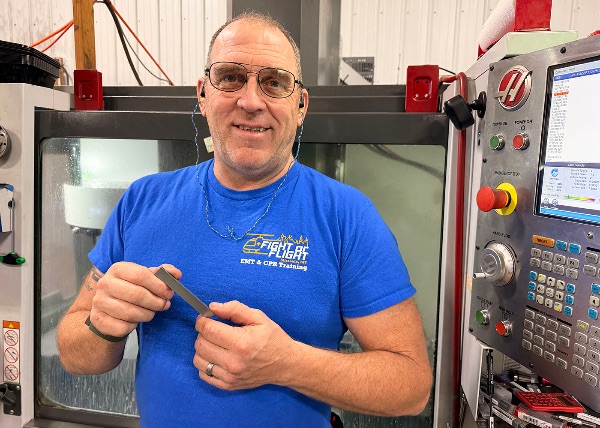
Paul is a multi-tour Middle East Veteran and local from the valley who keeps the machines running. His job is to take big pieces of steel or brass and turn them into smaller pieces. When he is done, the ends have been radiused, the dovetails have been cut, the tops sloped, and the holes are drilled and then either tapped or counterbored. Paul is a machine. He gets a lot done.
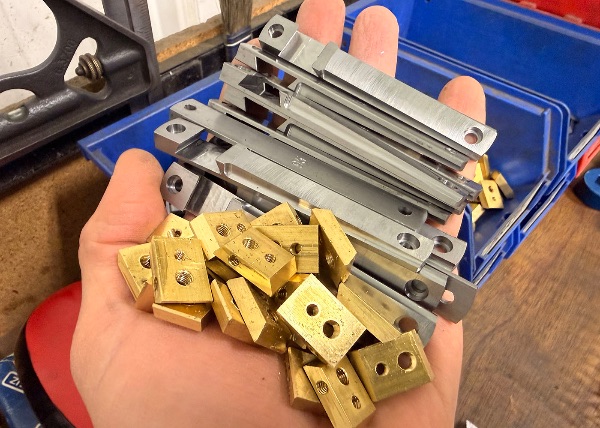
Aside from the Express blank, Paul runs the inserts so that they are beveled to fit the dovetail. Each of these has three holes that are tapped. One program and fixture drills and taps two of the holes while another operation drills and taps the side set screw hole.
Fitting and tapping
The rough sight now goes to Danny over at the fitting station. Danny, also a Veteran, pours his attention (maybe even love) into each sight. Some of them need tapping for which machine tapping wasn’t the best option, and some of them need the bottoms concaved. Danny takes an insert blank and hand fits it to the dovetail with learned skill and attention to detail. A thousandth of an inch matters here. That is 0.001 of an inch. If you don’t get that just right, the insert is undersized and will not work. (For example, a human hair is approximately .004”). Every sight with a dovetail is hand fit. Slop is not an option where durability and accuracy are on the line.
Sanding
Any surface that needs a fixturing mark removed or needs blended, is hand sanded. Julian and Ian (brothers) have touched hundreds of thousands of parts as they put their eye to the quality of each sight. Having sanded a decent amount my own self, this is a very ticklish skill. Keeping the angle straight. Not sanding off too much, leaving crisp clean lines, and smooth even transitions.
Finishing
Our final finisher is Keifer. He makes sure the parts are tumbled to soften sharp edges and blend the finish. Keifer blues the steel parts and this is a bit of a trick when it comes to hand fit dovetail parts. Each one is disassembled prior to bluing. For the BLACK GOLD “EXPRESS” sights, he keeps track of which brass insert goes to each sight he is about to run through the bluing process. He can’t scratch the sight or the dovetail insert after sanding and tumbling or it must be resanded and the process starts over. Keifer also runs the aperture lathe that makes 5 different sizes of apertures. After the CNC lathe sizes, threads and drills the aperture, Keifer does a second manual counterbore operation creating the “hood” to reduce sun glare.
Engraving/Assembling/Packaging
A few of our Sights have our maker’s mark engraved into the metal while curing in the CNC machine. However, most of them are laser engraved by our assembling crew. We also do custom engraving for a fee. When assembling the sights, the adjustment and mounting screws are put in place. Each one is then packaged with the correct wrenches and instructions. This packaging takes up minimal space and protects the part during shipping. Catherine and Ashley see to the assembling and packaging.
Shipping
This article is about making the sight. However, at this point we can’t leave our shippers/painters/office crew out. Rikki and Catherine do a great job getting your sight to you. You don’t get your sight without them!
Customer Service
When you purchase a Skinner Sight, Rob is an essential part of the package. He is our customer service guru. Every gun is slightly different, as is every ammunition load, and shooter combination. Helping you regulate the sights to ensure dead on accuracy is Rob’s forte. If you have a question, give Skinner Sights a call (1-406-745-4570) and you will get Rob to walk you through how to get your rifle to shoot like you want it to. He knows how tall your front sight needs to be…
Everything explained above is done in a shop, just outside of Saint Ignatius, Montana. Accurate, beautiful, and rugged, the Skinner Black Gold sight is more than just eye candy, it provides the precision needed to ensure your success on the range and in the field.
- By Dan Larsson
The Hunting Wire’s “Maker Series” takes you behind the scenes with the people who create the gear hunters and shooters rely on. Instead of talking about new gadgets, we focus on - and celebrate - the machinists, engineers, designers, builders, and the decision-makers in our industry. Want to share your Maker Series story? Reach out - jay@theoutdoorwire.com