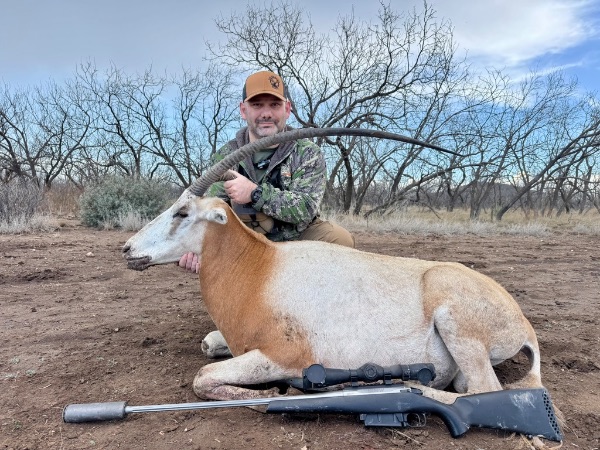
My first oryx hunt …
I went after one before I understood what that meant.
That changed fast. By mid-day, boot-deep in West Texas caliche, watching a watchful herd, my uncertainty turned to determination. The answer got simple.
You can admire an oryx from a distance. But admiration costs nothing.
Respect, on the other hand …
Respect is earned. It emerges when the wind shifts and the herd turns as one, when you realize you’re not just stalking them; they’re measuring you. Each step forward feels earned.
So do you have to hunt an oryx to appreciate it?
No.
But if you do, you’ll understand it differently.
Because somewhere between the first sighting and the final shot, admiration gives way to something heavier. The animal you thought you understood becomes deliberate. Uncompromising. That’s when respect takes hold.
That’s what hunting an oryx does to you.
And by the end, the question isn’t with the oryx, it’s with you.
Have you earned the honor of taking an oryx?
I’m not sure you ever feel like you’ve earned it until you’re in the middle of it.
Some people will tell you that hunting oryx outside of Africa misses the point.
I used to think that too.
I don’t anymore. That perspective changed once I experienced it here.
Texas isn’t a backup plan. It’s not easier or forgiving. If anything, it exposes you quicker.
You show up out of place, and Texas lets you know.
These animals may not have started here. But they belong here now.
And they demand the same thing from you as they would anywhere else: respect.
I showed up excited, ready for anything. I left humbled, changed by the experience and the animal.
The bull was quartering at a bad angle when I got behind the rifle. My setup, a Shaw Excursion custom build in 6.5-284 Norma, had already proven it could reach when needed. The rangefinder read 290 yards.
Now for the optics: the Leupold VX-6HD Gen 2 3-18x44 was flawless. I’ve never had a Leupold fail, no matter how tough the hunt.
I sent a 156-grain Norma Oryx bullet; the name felt fitting, in that instant, as it flew fast and sure. It’s a damned shame that Norma doesn't import its 6.5-284 in factory loads anymore.
Good hit. He dropped hard. We all thought it was over.
It wasn’t.
He got back up and took off as if nothing had happened.
Jake and Mason didn’t react, which at the time was reassuring. They’ve seen this sort of thing before, and with far worse shot placement. Oryx don’t quit easily.
When we walked up to where he fell, the ground told the truth. There was blood. A lot of it. And lung. Well, one lung, as we would soon find out.
Rain turned parts of the ranch into a mess, caliche and clay grabbing boots. Each step got heavier. Someone joked that maybe that made it fair: the oryx had one lung, we had ten pounds of mud on each foot.
But that same ground worked in our favor because the tracks were textbook clear. The blood showed bright red and glistened on the wet Texas terra. You could read the oryx's whole story in the dirt. We saw where he slowed, where he pushed, where he decided he wasn’t done yet.
Eventually, the trail dropped into a shallow draw.
We glassed ahead, and then we saw the herd, and our oryx was with them. He made it back to them - cue the theme from Rocky.
That stuck with me. It still does.
This oryx, tough as nails, had only one lung yet still outpaced us. I hit him hard; he still rejoined his herd. They closed ranks around him. When we moved in, the lead bull stepped forward, horns back, eyes warning us. I don’t speak oryx, but the message "FAFO" came through clear.
Wouldn't all of our lives be better if we had as loyal and protective friends as that oryx?
Then, the herd took off, and as he slipped to the back, we finally got our opportunity.
Sort of …
There are the shots you want to take, and then there are the shots you have to take. This was the second kind; all I had was what the locals call a Texas heart shot.
You sure, Jake? I asked. “Take it,” he whispered.
I pulled the trigger - pughhhhhhhhhhh (thank God for SilencerCo's Scythe Ti). The 156-grain Norma Oryx bullet went from butt to brisket; the oryx dropped like a stone.
Standing by him, I kept looking at that broken horn. A scar from winter. Just one more thing he’d already survived before we ever showed up. Then, I thought about the trail. How far he went. How did he get back to his herd? How another bull stepped in front of him.
When the hunt started, I liked this animal.
By the end, I loved it.
It doesn’t matter where the hunt happens: Africa or Texas.
An oryx always stands its ground.
I just hope I earned the right to stand beside it.
Jay Pinsky
Editor - The Hunting Wire & The Archery Wire