

New nationwide survey research by Responsive Management reveals that economic factors are to blame for the recent decline in Americas’ target shooting participation, with ammunition costs and less disposable income topping the list of reasons why fewer people today are going shooting.
Since 2009, Responsive Management has partnered with the National Shooting Sports Foundation (NSSF) to monitor participation trends in target and sport shooting. According to the two most recent trend surveys, recreational shooting participation remained essentially flat between 2020 and 2022 before declining during the period from 2022 to 2024. In 2022, the U.S. adult participation rate in target/sport shooting was 25.1%, essentially level with the 2020 rate of 24.1%; however, between 2022 and 2024, the rate declined to 20.8%—a statistically significant decrease equating to the loss of more than 10 million participants (p < 0.05).

The individual shooting activities with the most notable declines between 2022 and 2024 were target shooting with a rifle, target shooting with a modern sporting rifle, and target shooting with a handgun. Responsive Management’s analysis for NSSF also identified the demographic groups driving the downturn: between 2022 and 2024, participation in target and sport shooting declined most precipitously among those living in the southern region of the U.S., those between the ages of 18 and 34 years old, males, white residents, and hunters—some of the groups most closely associated with the traditional base of target shooters.
Because upwards of three-quarters of wildlife conservation funding in the United States comes from non-hunting target shooters, these trends have implications beyond just the shooting industry (fewer target shooters means less money available to state wildlife agencies for conservation work).
To investigate the specific reasons why fewer people are heading to shooting ranges, Responsive Management interviewed a large national sample of target and sport shooters to identify a representative subset whose participation has decreased within the last few years. (This effort required screening out the significant number of respondents whose participation increased or remained about the same since 2022.)
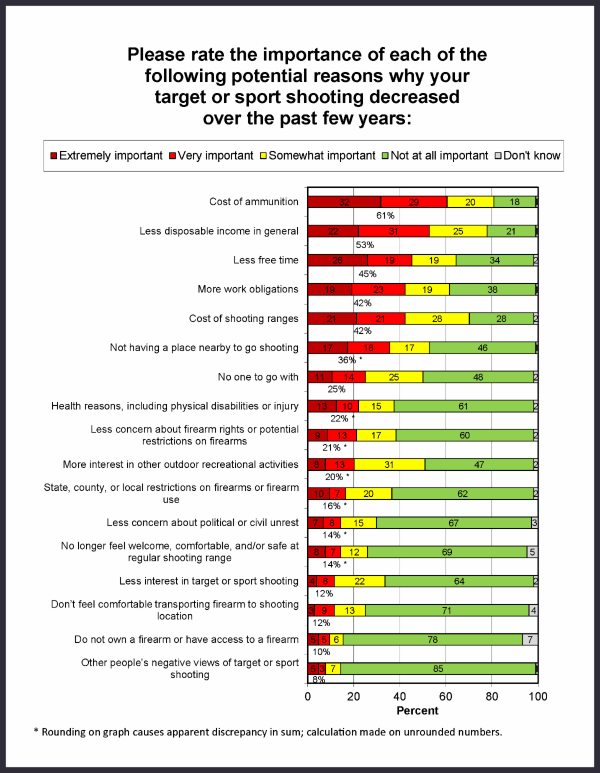
Confirmed target and sport shooters who said they were shooting less now compared to a few years ago were then asked to rate the importance of various potential reasons for their decreased participation. The list consisted of seventeen items ranging from social reasons and resource-related issues to more general factors like loss of interest and time constraints.
The results paint a clear picture of the causes of the recent decline in target and sport shooting, with three of the five top factors directly relating to economic considerations: cost of ammunition (61% of those who are shooting less rated this as an extremely or very important reason), less disposable income in general (53%), and the cost of shooting ranges (42%).
The top tier is rounded out by two other reasons that may also relate to the pressures of the current economy: less free time (described as an extremely or very important reason by 45%) and more work obligations (42%).
These reasons far outweigh the impact of factors like access, health issues, competing interest from other activities, and other potential drivers of declining participation.
While these findings shed light on ways to help reverse the downward trend in target and sport shooting, the overall participation numbers must be kept in perspective: target shooting remains a hugely popular activity in the United States, with one in five American adults (or more than 52 million individuals) continuing to participate.
For more information about this survey or other research conducted by Responsive Management, please contact us at mdd@responsivemanagement.com.