
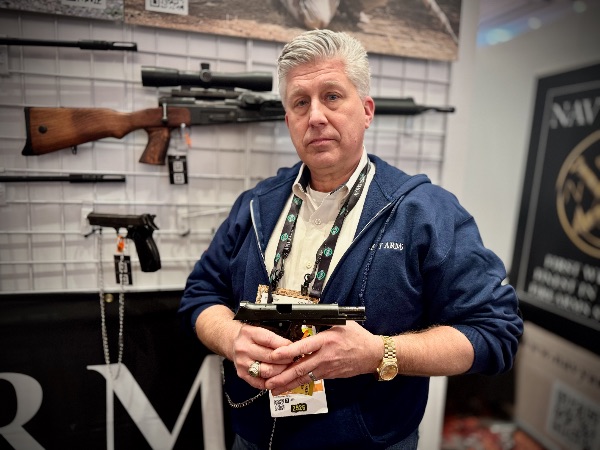
Most hunting camps I’ve been in have at least one “back in my day” guy, always ready with a story about the old days. I guess the younger guys call them “boomers.”
Usually, those “remember when” stories are about people who aren’t around anymore. But if you're fortunate enough to have someone like Val Forgett from Navy Arms in camp with you, the talk will turn to guns, and how your shiny new rifle is really just the grandkid of some old warhorse, or how that red-dot-wearing lever action you love is more battle-proven than you will ever be
You see, Navy Arms helps us remember and celebrate the tactical long before it was, yeah - tacti-cool.
For Val, vintage firearms aren’t just works of wood and metal to be gawked at; they're ingenious, useful, and ever-evolving tools of history.
“We define historic arms as both original versions of weapons as well as replicas,” he told me. “Modern-made, but look and behave like older guns.”
For hunters, that definition should ring familiar.
Bolt-action rifles? The ones we all use for deer and elk? They started with the Mauser brothers and the army, not in a tree stand. That old feed system everyone loves now was proof-tested in foxholes, not tree stands.
Lever guns? Oh boy, using them for hunting is and always has been a side hustle. The lever gun was built for combat.
What Navy Arms is doing, bringing back old military guns and making copies that work, is about more than nostalgia. They offer hunters a bridge to the roots of the sport by making historically important firearms accessible and usable in the field today.
Hunters today want new things. Lighter, faster, more gadgets. That’s fine, but let’s not forget where it all came from.
For a lot of us, that first rifle wasn’t new. Maybe it was your dad’s old gun, or some army surplus you found for cheap. Maybe you just liked how it felt. And you weren’t scared to scratch it up.
That’s where Navy Arms stands out for me. They serve as a vital link between heritage and today’s hunts, giving modern hunters access to both the craftsmanship and practical reliability of classic firearms.
On the vintage side, they import original military surplus and European sporting arms, including side-by-side shotguns, over/unders, and bolt-action rifles, all built when craftsmanship mattered because replacement was not guaranteed.
On the replica side, Navy Arms fills another role hunters understand instinctively: protect the original, hunt with the stand-in.
"If a guy loves original Mauser rifles," Forgett explained, "but does not want to shoot one, he can shoot his replica."
That logic applies directly to hunting. Original rifles carry history and value. Replicas let hunters experience classic handling and design without the anxiety of damaging an irreplaceable item.
Hunters live in the middle ground between collectors and shooters.
I'll confess freely that every rifle I own has battle scars from being hunted with, from my plinking 22’s to my 1960’s-era Sako chambered in 264 Winchester Magnum. There are no stunt-doubles in my safe.
But not everyone thinks the way I do. Some folks think a gun’s only value lies in its existence and not in its purpose.
Forgett understands that divide because Navy Arms serves both sides.
They sell collector-grade originals: untouched, historically correct, premium-priced. But they also sell refinished, shooter-grade versions of the same rifles. Guns that are mechanically sound, accurate, and ready to be used without guilt.
"If you nick it up," Forgett said of those shooter-grade rifles, "you are not harming an original finished gun."
That matters in the hunting world.
A hunting rifle gains its story the hard way: rain, mud, long miles, or, like me, being dropped when you fall flat on your face when you're packing out a mule deer in Idaho. If yours is too fancy to carry, it shouldn’t be your hunting rifle. And for me, if a gun can't be hunted with, well, I don’t want it.
Here’s something nobody in the hunting world says enough:
A lot of us didn’t grow up as hunters.
Some of us start out as history nerds, or target shooters, or just people who buy an old army rifle because it’s cheap and looks cool. Then one day you realize you love shooting, and hunting is just the next step.
From there, the transition to hunting is natural.
Forgett sees this bridge clearly.
He points new shooters toward rifles that are plentiful, durable, and readily available with ammunition, such as CMP-sourced M1 Garands and 1903 Springfields, and Mauser variants from Spain, Chile, or Portugal. Guns that teach marksmanship before they ever teach marketing.
And once someone understands those rifles, the leap to hunting makes sense.
One of the most interesting parts of the conversation was Forgett’s view on how historic arms still influence modern hunting, not just aesthetically but functionally.
Bolt actions and lever actions remain dominant hunting platforms for a reason. They work. They handle recoil well. They balance naturally. And they trace directly back to military designs that proved themselves over decades of real-world use.
You think buck fever is bad, try staring down the barrel of your rifle after you stormed Normandy Beach, and a miss meant the only thing your momma will have to remember you by is the letter she got from the government.
Even the AR platform, still controversial in some hunting circles, follows the same pattern. Originally military. Then adapted. Now, it is increasingly common for hogs, predators, and game where fast follow-up shots and modularity make sense.
Suppressors follow that same arc. Long accepted in European hunting as a courtesy and safety tool, they are finally being understood in the U.S. for what they actually do: reduce sound to safer levels, not silence rifles.
Hunters didn’t invent these ideas. They adopted them once they proved useful.
When I asked Forgett about undervalued firearms, his answers surprised me and should surprise hunters, too.
He pointed to Martini rifles, especially .22 LR target variants, as being overlooked in the U.S. market despite exceptional accuracy and build quality. In Europe, comparable rifles command much higher prices.
For hunters who appreciate precision and simplicity, the Martini action, a single-shot falling block, represents the kind of discipline that makes better shooters. One shot. Make it count.
He also mentioned “Drillings” (a German term for a specialized three-barreled combination gun, typically featuring two side-by-side shotgun barrels over a single rifle barrel) as highly valued overseas. Often ignored in the U.S.
For the right hunter, a drilling is the ultimate "one gun" solution. Birds. Small game. Big game.
One of the most important points Forgett made had nothing to do with ballistics or calibers.
He talked about collecting as the "fourth reason" people own firearms, alongside defense, hunting, and recreation, and how it is often left out of the conversation.
"When it comes to collectible guns," Forgett said, "you are not selling a gun, you are selling a story."
Hunters understand that better than anyone.
Every rifle that comes back from a hunt has a story, some you want to tell to everybody and others you'd rather keep to yourself.
Navy Arms is entering its third generation of ownership. They preserve the designs that taught the world how to hunt with rifles in the first place. They keep those designs accessible, shootable, and relevant. They remind modern hunters that innovation did not erase the past; it was built on it.
In a world obsessed with what’s next, Navy Arms quietly challenges you: remember where your rifle came from, and understand that each hunt traces a line from the past to your hands today. That connection is not nostalgia; it’s the foundation of every true hunt.
Jay Pinsky, Editor, The Hunting Wire & The Archery Wire
jay@theoutdoorwire.com