
By Shane Jahn
Rossi Firearms were once best known for their budget-priced renditions of the Winchester 1892 (R92) and a few double action revolvers. Today’s Rossi empire is turning out several types of firearms and some of you will be surprised to learn that Rossi has been around for 136 years!
The R92 is still readily available in a variety of configurations and is a fine lever gun to add to your rifle rack. They are well-made, accurate, and pleasing to the eye, as only a good lever-action rifle can be. I used their Rio Bravo in .22 LR for an article in the Gun Digest Lever-Actions book released last year. For under $400 this little tack-driving carbine is very accurate and a lot of fun to shoot. It came as no surprise that the larger R95 in .30-30 Winchester followed suit in value and accuracy.
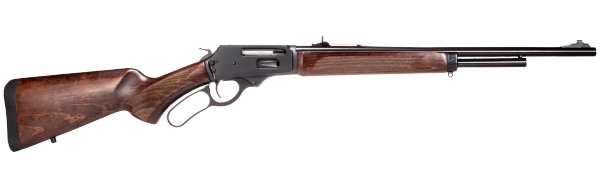
The R95’s action is very similar in appearance to Marlin’s 336 and its’ function is as smooth as running a knife through warm butter. The stained wood of the stocks gives the rifle a handsome flare and an old-school look of all-business. It’s not overly fancy or shiny but adds just a touch of rugged exterior that fits well with the gun. The flexible kick pad might not be needed for the mild recoil of the .30-30, but it fits well and makes the rifle comfortable to shoot. The receiver is a matte finish with more polished barrel and mag tube. Both finishes are black oxide. The rear sight is an adjustable buckhorn, and the front is a drift-adjustable bead.
I removed the rear sight and added one of Skinner Sights good peeps and applied a touch of orange sight paint to the front bead which shows up quite well. When Skinner Sights unveiled their small red dot, called the SKO-212 RDO, I added it to the rifle for testing. This little sight weighs 3.8 ounces and is two inches in length and about 1.75 in height if you include the mount and vertical adjustment knob. It mounts low and works well, providing a 2 MOA LIT DOT that shows up well in the field. This red dot sight is made to follow the sleek lines and natural- pointing characteristics of the lever gun. It is an especially good option for those who have trouble seeing iron sights and for anyone hunting in low light. This optic does not magnify the target and there are several intensity settings for the dot making it easy to adjust for hunting and shooting conditions.
The trigger isn’t particularly light, measuring about 4 pounds, but it does break crisp, and my three-shot groups measured around 1.75 to 2 inches at 50 yards
Late season hunts in Texas normally reveal an enormous number of white-tailed deer sightings. For one, we’ve usually had some freezing weather by then and many of the forbs that deer feed on will be in shorter supply. The rut will have run its course for the most part and the deer are hungry. Texans enjoy the advantage of being able to feed deer and slinging corn will pull them out of the brush. It helps the deer with a little extra grub, and it helps the hunter by providing a good opportunity to view many deer that would otherwise remain unseen in the juniper and mesquite thickets. These extended viewings allow hunters to carefully select deer to be taken out of the herd to fit in with the ranch’s wildlife management program. It may be an old doe past breeding age, an ancient buck with worn teeth, or a tight-horned mature deer that doesn’t carry the desirable genetics we hope will be passed on to future generations.
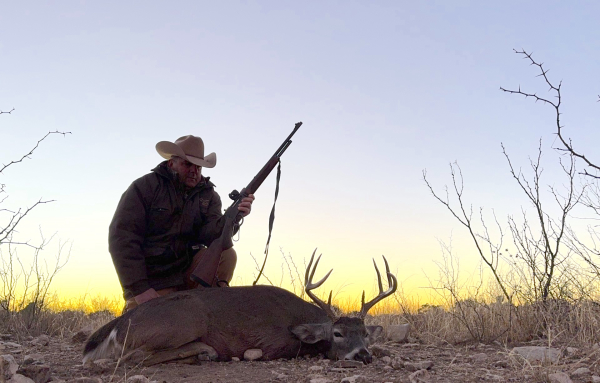
I was on such a hunt last January when a mature 8-point with a narrow spread sauntered out of the brush. He was fully mature with his legs appearing short due to the depth of his chest and body. His head appeared blockier than the rest, and his antlers showed plenty of knurling (or pearling) at their bases indicating age and good nutrition. The past year had seen plenty of rain and the deer were in good shape. Conditions like this can be rare in the Trans-Pecos Region. A mature buck in a year like this would be about as good as he would ever be. The old buck walked a little more slowly and with a more determined purpose than the young two and three-year old bucks that fed among the many does and yearlings in the clearing. Most of the younger males had better antlers than this patriarch, but he fit my definition of a trophy deer as he had survived over five years of predators, parasites, and a few other things that cause mortality in whitetail deer, including death by a hunter’s bullet. These old deer are cautious and sometimes almost completely nocturnal. Any mature and post-mature buck is a trophy, no matter what his horns look like.
I saw this deer on a previous hunt and immediately recognized him when he appeared a couple hundred yards in the distance. I decided I would take him if he got close enough and offered a good shot presentation, which proved to be a challenge in the melee of constantly moving deer. Perched in an old, open-topped quad pod with a few cedar branches hung from the rails for camouflage, I watched and waited. The old deer milled amongst the others but showed no interest in moving closer for a long period of time. Just before sunset, he started making his way ever so carefully in my direction, now I had to wait for a broadside shot. Making his way to the west, the buck turned towards me, walking towards to a fresh scrape just south of the blind. I steadied the Rossi and watched as he slowly covered another 50 yards and walked through the small clearing separating a large bunch of prickly pear and a bush about 40 yards away.
As he entered the clearing, he began to turn for the scrape, and I made a low bleat that stopped him mid-stride. The red dot was settled on his right shoulder and the crack of the .30-30 sent Buffalo Bore’s 150 grain Barnes TSX right for its mark. Hit hard, the old buck struggled to stay on his feet and ran smack into a mesquite tree. The crash of his impact and the plume of dust that hung in the windless seeping cold of sunset made for a dramatic end to an aging whitetail, a much more valiant death than starvation by worn teeth, parasites, or an agonizing ending of being eaten alive by coyotes. As hunters, we can give a noble death to an animal and memorialize them in taxidermy and delicious meals shared with family and friends. It’s an honorable role we play in the balance of nature by doing our part in wildlife conservation. Collecting a few to ensure the benefit of the majority. The entire process is even sweeter when we use a good lever-action rifle like this Rossi R95!